

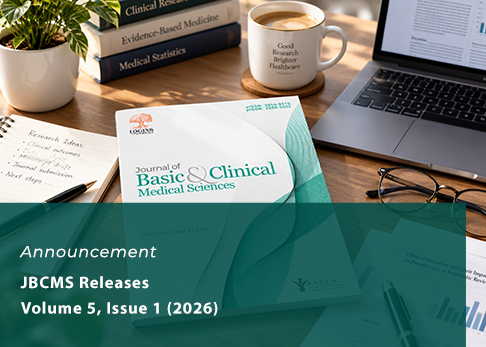
JBCMS Releases Volume 5, Issue 1 (2026)
Lahore, Pakistan — March 31, 2026: The Journal of Basic & Clinical Medical Sciences (JBCMS) is pleased to announce the completion of Volume 5, Issue 1 (2026), now available online. This is the first issue of the journal’s fifth year of publication and the first of its two issues for 2026. The issue contains five original research articles and one Viewpoint, published during March 2026. Together they address rehabilitation, chronic disease management, public health, and the responsible use of artificial intelligence in medicine.
The issue opens with a randomized study by Irum Farooq and colleagues on the effects of segmental muscle vibration on upper limb function in subacute poststroke patients. Twenty-eight patients received vibration therapy at 60 Hz or 120 Hz alongside conventional physiotherapy, or conventional physiotherapy alone, for eight weeks. Upper limb function and spasticity improved in all three groups. However, the differences between the groups were not statistically significant, and the two vibration frequencies produced similar results.
Two articles focus on type 2 diabetes. Gul Zareen Asifa and colleagues examine the association of HbA1c with lipid profile in patients with type 2 diabetes mellitus and cardiovascular disease. Higher HbA1c levels were associated with older age, higher body weight, and raised blood pressure, while higher HDL cholesterol was associated with lower HbA1c. The authors call for clinical management that targets blood pressure, blood glucose, and lipids together.
In the second diabetes study, Ayesha Tahir and colleagues look beyond the prescription at self-management practices and their sociodemographic determinants among 483 patients in Sargodha, Punjab. Most patients regularly monitored their blood glucose. Only about a quarter, however, had their HbA1c tested every three months, and fewer than half practiced stress management. Older and unmarried patients were less likely to manage their condition adequately and may need targeted support.
In tobacco control, Muneeb Ghumman and colleagues compare health-risk knowledge of cigarette smoking and attitudes toward pack warning labels among adult smokers and nonsmokers in Punjab. Among 406 adults surveyed in Ichhra, Lahore, nonsmokers were better informed than smokers about the harms of smoking. Smoking, a rural background, and lower income each independently predicted poorer knowledge. The findings suggest that health messaging should give priority to smokers and people from rural backgrounds.
Atabiq Javed and colleagues then report on the effects of muscle energy technique and core stability exercises on pain and disability in adults with sacroiliac joint dysfunction. Both treatments substantially reduced pain and disability among 72 adults treated at a private hospital in Lahore. The muscle energy technique gave greater pain relief, and disability outcomes were similar for the two treatments. Because patients were not randomly allocated, the authors recommend randomized trials to confirm these findings.
The issue closes with a Viewpoint by Atif Adnan, Algorithmic blind spots: bias, opacity and the clinical translation gap in artificial intelligence-driven personalized medicine. The author argues that reported model performance often overstates real clinical value, and that few artificial intelligence tools have been tested prospectively. He traces the gap to opaque models, unrepresentative data, and the lack of shared standards for evaluation and oversight. He proposes a five-stage framework running from representative data to monitoring after deployment. For low- and middle-income countries, he calls for locally governed data and regional validation networks rather than reliance on imported tools.
All articles in this issue are freely available to read and download. The editorial team thanks the authors, reviewers, and editorial board members whose work made this issue possible. Researchers, clinicians, and health professionals are invited to explore the issue and to submit original work for future issues of JBCMS.
Explore Volume 5 | Issue 1: Click Here
Learn More and Submit Now: Click Here